Menu
BRAND. For lab. For life.®

Handling of glass burettes

What are burettes?

Burettes are precise volumetric instruments used to carry out exact analyses. Conventional burettes consist of a long, graduated glass tube and feature a device to deliver a solution precisley, typically a stopcock or valve. They are calibrated to “Ex” (TD = to deliver).


Burettes are primarily used for titrations in volumetric analysis. The scale indicates the volume of liquid delivered until the required reaction point or endpoint is reached.
 

  • Calibration
    Class AS: 'Ex + 30 s'
    Class B:   'Ex'
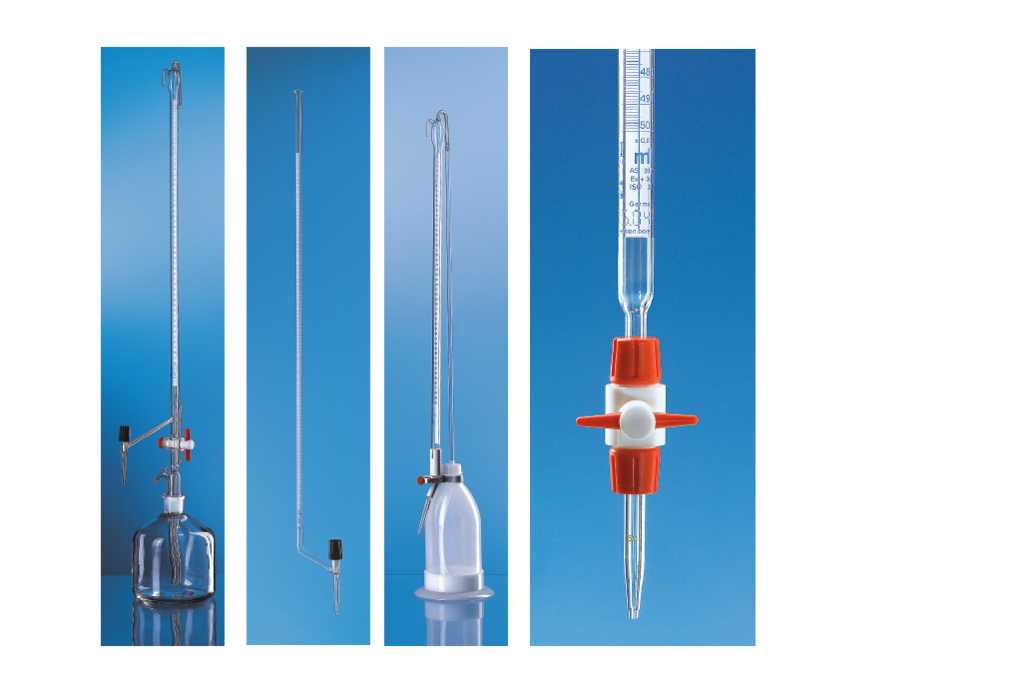
What types of burettes exist?

Burettes are available in various designs that differ in terms of construction, operation, and readability:

Glass burettes
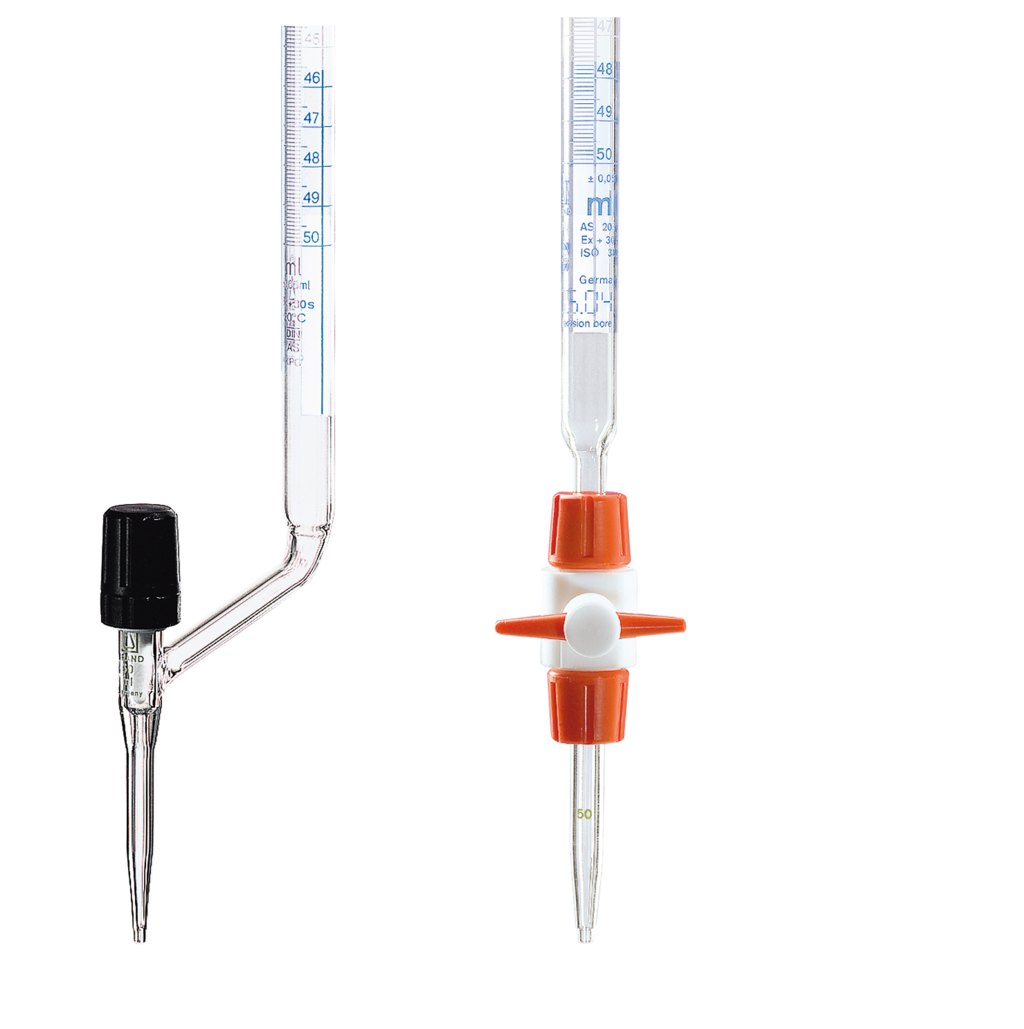
Glass burettes are available with different stopcock and valve designs. There are also Schellbach burettes featuring a colored stripe that makes it easier to read the meniscus.

Automatic burettes / titration apparatus
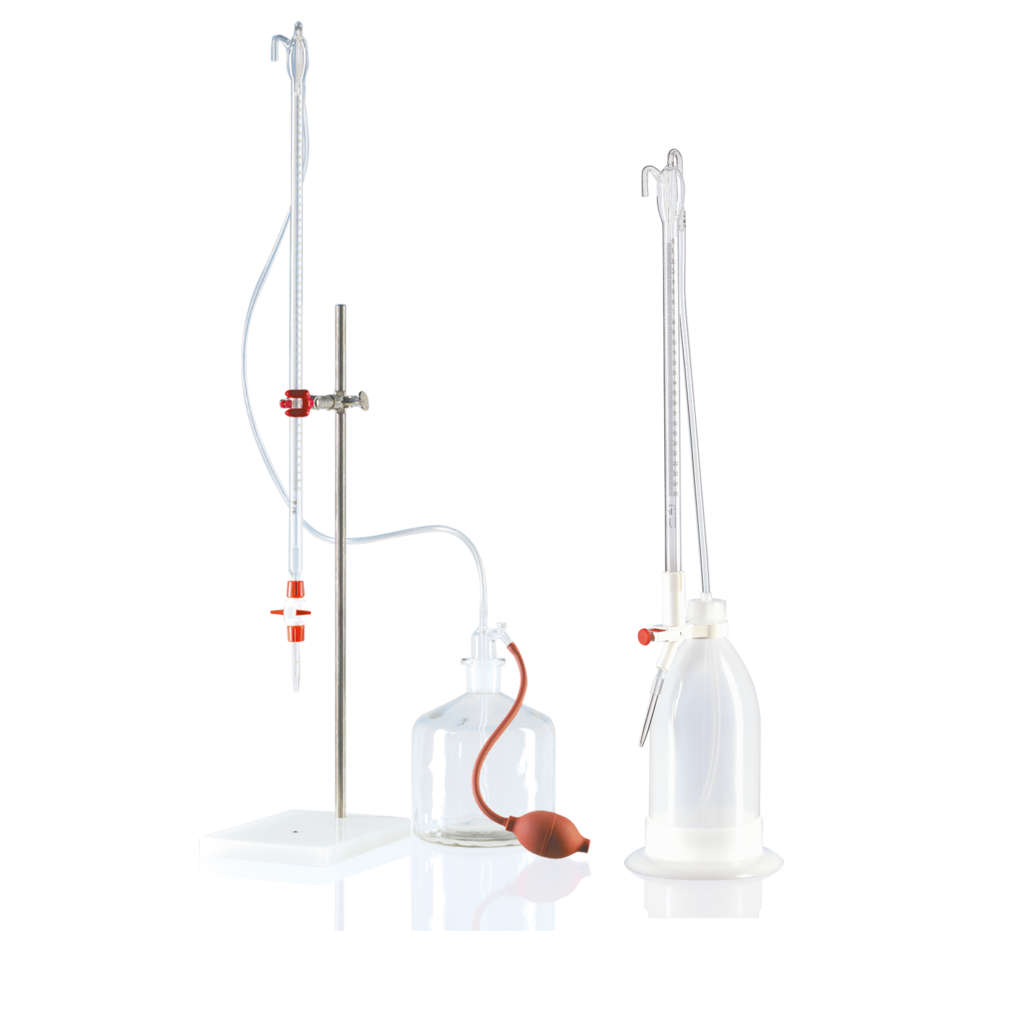
Automatic burettes and titration apparatus feature automatic zero-point adjustment at the top, allowing convenient filling from a reservoir bottle.


There are also digital burettes, in which the delivered  volume is measured electronically and shown on a display, such as the Titrette® from BRAND. However, this article focuses on conventional glass burettes and their different designs.

How to work with glass burettes

1. Rinse the burette with the standard solution to be used, and align burette tube vertically. 


2. Fill the burette slightly above the zero mark. To prime the stopcock, drain the burette no further than the nominal capacity. 
 

3. Refill the burette with titrant free of air bubbles to approx. 5 mm above the zero mark. 
 

4. Drain liquid to set the zero point accurately. Important: Meniscus must be read at eye level (parallax-free level). Automatic burettes: Fill to approx. 5 mm above the zero mark. This is adjusted automatically after air release.
 

5. Wipe off any drops adhering to the discharge tip.
 

6. Open the stopcock and slowly add titrant to the sample (containing the indicator). The discharge tip must not touch the wall of the vessel. Keep swirling the sample vessel lightly while adding titrant, or place it on a magnetic stirrer. 
 

7. Read the discharged volume at eye level.


8. Any drops remaining on the tip of the stopcock   should be wiped against the vessel wall and rinsed down. It is part of the titrated volume.


Note on waiting time
Compared to glass pipettes, the handling of glass burettes is different during practical use and calibration. Typically, the volume used in a titration is less than the nominal volume, and the standard solution is added dropwise when close to the color change to avoid overtitration. In practice the time required for this dropwise addition is the same or even longer than the established waiting time. As a result, it is not necessary to observe the established waiting time of 30 s with class AS burettes during practical use.
Note on titration
In addition to burettes, volumetric flasks, bulb pipettes and Erlenmeyer flasks are required for titrating. For easiest recognition of the color change, place the sample vessel on a white surface. Make sure that the solution is completely homogenous. There must be no cloudiness, flocculation or precipitation present. The titration is finished, when the color change is reached. Before each new titration, reset the zero point and start the titration from there.

Discover the best burettes for your application from BRAND

Burette, BLAUBRAND®, AS, DE-M, 10:0.02 ml, Boro 3.3, lateral stopcock, PTFE key, blue Schellbach stripe

Burette, BLAUBRAND®, AS, DE-M, 10:0.02 ml, Boro 3.3, lateral stopcock, PTFE key, blue Schellbach stripe

Boro 3.3. To DIN EN ISO 385. Calibrated to deliver (TD, Ex). Schellbach stripe. Length approx. 800 mm. All BLAUBRAND® burettes are delivered with batch number and enclosed one batch certificate per packing unit of the manufacturer. On demand also available with individual certificate, USP Individual certificate or DAkkS calibration

view product
Auto. burette, BLAUBRAND®, class AS, DE-M, 10:0.02 ml, lateral valve cock, intermediate stopcock w. PTFE key, without bottle, blue Schellbach stripe

Auto. burette, BLAUBRAND®, class AS, DE-M, 10:0.02 ml, lateral valve cock, intermediate stopcock w. PTFE key, without bottle, blue Schellbach stripe

DIN EN ISO 385. Clear glass, Boro 3.3, calibrated to deliver (TD, Ex) and with Schellbach stripe, valve cock with PTFE spindle for titration as well as PTFE intermediate stopcock for draining residual liquid, automatic zeroing. Overall height approx. 95 cm. All BLAUBRAND® automatic burettes are delivered with a batch number and batch certificate included in the original packaging. They are also available with individual certificates or DAkkS calibration certificate upon

view product
Automatic burette Schilling, SILBERBRAND, 10 ml, Boro 3.3, with PE-LD bottle 500 ml, black Schellbach stripe

Automatic burette Schilling, SILBERBRAND, 10 ml, Boro 3.3, with PE-LD bottle 500 ml, black Schellbach stripe

Burette: Boro 3.3. Error limits according to class B, DIN EN ISO 385. Calibrated to deliver (TD, Ex). Schellbach stripe. Automatic zeroing. Materials:Filling tube: PVC,Discharge tube: silicone,Reservoir bottle: PE-LD,Base: PE-HD,Fitting, grey: Polyamide,Micrometer screw: brass/PP. Squeezing bottle allows rapid filling. Automatic zeroing. Micrometer screw allows fine titration. Rough titration by releasing the micrometer screw and using the press

view product
Compact burette, BLAUBRAND®, cl.AS, DE-M, 10:0.02ml, Boro 3.3,PTFE stopcock, blue Schellbach stripe

Compact burette, BLAUBRAND®, cl.AS, DE-M, 10:0.02ml, Boro 3.3,PTFE stopcock, blue Schellbach stripe

The new Generation of Burettes from BRAND. With PTFE stopcock, fast to dismantle and easy to clean. Simple repair - all individual components replaceable. Boro 3.3, removable PTFE stopcock. To DIN EN ISO 385. Calibrated to deliver (TD, Ex). Schellbach stripe. All BLAUBRAND® burettes are delivered with batch number and enclosed one batch certificate per packing unit of the manufacturer. On demand also available with individual certificate, USP Individual certificate or DAkkS calibration

view product

More information on volumetric instruments

Learn everything you need to know when working with volumetric instruments

Explore all laboratory volumetric measuring instruments, applications, standards, certificates and proper handling – backed by 75+ years of BRAND expertise.

to the site
Dr. Christian Schurz
Product Manager Glass & Plasticware | Expert in Volumetric Measuring Instruments

Dr. Christian Schurz has been a Product Manager at BRAND GMBH + CO KG in Wertheim for over 13 years, specializing in volumetric measuring instruments. He is actively involved in standardization as a member of the DIN Working Committee on Volumetric Instruments and as an expert and project leader in ISO/TC 48/SC 8/WG 1 (Glass and Plastic Volumetric Apparatus). After earning his degree in Chemistry (Diplom) at TU Bergakademie Freiberg, he completed his PhD in Inorganic Chemistry at the University of Stuttgart. He continued his scientific career as a postdoctoral researcher before joining BRAND in 2013.

BRAND GMBH + CO KG

Otto-Schott-Str. 25
97877 Wertheim
Germany


info@brand.de

T +49 9342 808 0

General terms and conditions

for orders from outside shop.brand.de

for online orders on shop.brand.de

Delivery countries for online orders on shop.brand.de

Secure payment

Note: Our offer is directed exclusively to traders.

Subscribe to our Newsletter

I can revoke this consent at any time with effect for the future by contacting privacy@brand.de. Further information on data processing can be found in the privacy statement.

By submitting the contact form, you agree that your data will be used to process your request. If your inquiry originates from a country where we do not have our own sales department, you also consent to the forwarding of your data to the responsible local sales partner. You can find an overview of our sales partners on our contact page. Further information on data processing, including possible transfers to third countries, can be found in our privacy statement.

Fields marked with * are required.