Volumetric Instruments in the Laboratory Types, Applications, Certifications and Standards
Volume measurement is one of the fundamental tasks in the laboratory, and a wide range of different volumetric instruments from BRAND are available for this purpose. On this page, you will find a compact overview of the most important types of instruments, typical applications, as well as key aspects relating to certificates, standards and handling, based on BRAND’s more than 75 years of experience in the field of volumetric instruments.
- What are volumetric instruments?
- What types of volumetric instruments exist?
- What are volumetric instruments needed for in the laboratory?
- How do volumetric instruments differ from one another?
- What should be considered when handling volumetric instruments made of glass or plastic?
- What certifications are available for volumetric instruments?
- Which standards apply to volumetric instruments?
- Sources
- FAQ
What are volumetric instruments?
Volumetric instruments in the laboratory (whether in chemistry or biology) are special measuring instruments used to measure, dispense or transfer liquids as accurately as possible. They are classified as inspection and measuring equipment, i.e. instruments that make it possible to reliably verify agreed characteristics (e.g. concentration, content, titer) in the first place. They are primarily used for preparing analyses of liquids and for the actual analysis itself.
It is important to note that in the laboratory, volume is often not merely an “auxiliary quantity”, but part of the measured value (e.g. in titration). For this reason, volumetric instruments differ fundamentally from measuring cups or household measuring vessels: they are designed according to standards, error limits, type of adjustment (In/Ex) and a reference temperature, and they must be regularly monitored and calibrated, particularly in regulated environments.
 Remember:
What types of volumetric instruments exist?
Several basic types have become established in the laboratory. They differ primarily in whether they provide a fixed target volume or allow variable partial volumes, how they are adjusted, and how strongly the result depends on reading and handling (meniscus, delivery/waiting time, wetting).
The most important types of volumetric instruments made of glass or plastic are:


In addition to the volumetric instruments made of glass or plastic described here, liquid handling instruments according to DIN EN ISO 8655 (e.g. Dispensette®, Transferpette® or HandyStep®) are also classified as volumetric instruments. These use a piston and therefore have a different operating principle than volumetric instruments made of glass or plastic.
What are volumetric instruments needed for in the laboratory?
Volumetric instruments are needed whenever a volume has to be set precisely or used as a measured quantity. This is the case wherever analytical results such as concentrations or dilution factors are derived directly from volume. A simple classification helps with the selection: sample preparation (volume as a reference) vs. analysis (volume as part of the measured value).
1. During preparation for analysis
In sample preparation, the main objective is usually to bring a sample to a defined volume or to transfer volumes reproducibly:

- Standard solutions & dilution series: Volumetric flasks (fixed volume) are the standard because the volume either serves as the reference for determining concentration (solutions to be analyzed) or is used to obtain defined concentrations in dilution series. The latter is required for calibrating instruments such as spectrometers (UV/VIS, AAS, AES, OES, IR, MS, etc.) or chromatographs (HPLC, GC, etc.).
- Before a titration (one method of analysis), volumetric pipettes are needed to transfer solutions to be analyzed.
- Defined additions (buffers, indicators, reagents): Volumetric pipettes (fixed) or graduated pipettes (variable) – depending on whether the same volume is always required or flexible working is needed.
- Preparing mixtures: Graduated/mixing cylinders can be a practical alternative when several solutions are combined in defined partial volumes (with the trade-off between convenience and accuracy).
2. During the actual analysis
In many methods, the precisely added or consumed volume is itself part of the measurement, e.g. in titration. In such cases, instruments such as burettes or titration apparatus are used, where precise adjustment, good handling and reading of the volume are crucial.
In the laboratory, such instruments are important because even small volume errors can change concentrations and thus distort analytical results. Many volumetric instruments are therefore designed for specific volumes, accuracy classes and applications.

At a glance: Application & typical instrument
Application
Typical instrument
Volumetric flask
Volumetric pipette
Graduated pipette
Burette/titration apparatus (automatic burettes)
Graduated/mixing cylinder
How do volumetric instruments differ from one another?
Volumetric instruments differ primarily in terms of volume type (fixed vs. variable), adjustment (In vs. Ex or TC vs. TD), accuracy class (A vs. B), and material (glass vs. plastic).
The 4 most important distinctions between volumetric instruments are:
1. Fixed vs. variable volume
- Fixed volume: A single ring mark indicates the nominal volume for the reproducible preparation or transfer of a fixed volume. The design combines a large body for the main portion of the volume with a slender, cylindrical neck with a small diameter (e.g. volumetric flasks and volumetric pipettes).
- Variable volume: A continuous scale allows different partial volumes to be set and read. The cylindrical body with a larger cross-section represents the respective error limit at each individual volume over the entire scale range (e.g. burettes, graduated pipettes, graduated/mixing cylinders).
2. In vs. Ex oder TC vs. TD
- In: The instrument is manufactured so that it contains the nominal volume. When pouring out, a residual amount of liquid always remains.
- Ex: The instrument is manufactured so that it delivers the nominal volume. After delivery, a defined residual amount may remain in the instrument. A specified waiting time may be part of the specification and must be observed.
At a glance: Volumetric instruments and their measuring principles
Measuring Instrument
Adjustment
Principles
Ex / TD
Small cross-section, fixed volume
Ex / TD
Large cross-section, variable volume
In / TC
Small cross-section, fixed volume
In / TC
Large cross-section, variable volume
Ex / TD
Usually small cross-section, variable volume
3. Class A vs. Class B
- Class A (AS/AW): Refers to the highest accuracy class, i.e. the smallest error limits. Volumetric instruments of this class are therefore suitable when low measurement uncertainties are required (e.g. for calibration work, analytical applications). Wide-neck volumetric flasks have a neck with a slightly larger cross-section and are designated as Class AW, as they therefore also have a slightly higher error limit compared to Class A volumetric flasks. Class AS volumetric instruments are always adjusted to Ex. The suffix “S” means fast delivery.
- Class B: The tolerances are larger than for Class A and are therefore intended for preparatory work where speed, robustness or cost are the main priorities. Here, too, there are wide-neck volumetric flasks which, due to the larger cross-section and the associated increased error limit, are designated as BW.
The larger the cross-section (inner diameter at the ring mark), the greater the absolute error!
DIN EN ISO 384: MPE ≥ 0,25 x π x D2 x (0,4 + 0,01 D)
(simplified formula) MPE = error limit
D = inner diameter at the ring mark
4. Glass vs. Plastic
- Glass (for volumetric instruments, generally borosilicate glass or soda-lime glass): Very dimensionally stable and therefore has low thermal expansion. It is transparent and offers high chemical resistance to acids, alkalis or aqueous solutions, with the exception of hydrofluoric acid (HF). Volumetric instruments made of glass change their volume only very slowly, particularly as a result of cleaning.
- Plastic (e.g. PP, PMP, PS): Is necessary when glass is unsuitable (e.g. for HF or in trace analysis depending on the element/matrix, boron, aluminium), but has different limitations in terms of chemical and temperature resistance compared to glass. Plastic is characterized by high break resistance and lower weight. PMP and PFA are also used for measuring instruments that comply with Class A error limits.
Remember:
What should be considered when handling volumetric instruments made of glass or plastic?
The following key points are important when handling volumetric instruments:
Read the meniscus correctly
When read correctly, volumetric instruments made of glass are the most accurate measuring instruments for volumes in the laboratory.
Find out here how to read the meniscus correctly.
Correct handling
Requirements regarding waiting times, angle and wiping affect the precise volume and must be observed depending on the instrument.
More information on handling the individual volumetric instruments.
Observe the reference temperature
The specified volume refers to the reference temperature indicated on the volumetric instrument (typically 20 °C), at which the instrument was calibrated. For the most accurate measurement results, the same temperature should be maintained whenever possible. In the case of significant deviations from the reference temperature, temperature-related volume changes must be taken into account in calculations.
Ensure cleanliness and wetting
Residues, e.g. grease films or limescale deposits (powder), interfere with wetting and distort the meniscus.
Clean, rinse and dry before use.
Find out more about the correct cleaning of laboratory equipment here.
Inspection and calibration status
A visual inspection should be carried out before each use (e.g. cracks, chipped edges, damaged scale).
In addition, regular recurring calibrations should be carried out in accordance with measuring equipment monitoring.
What certifications are available for volumetric instruments?
A basic distinction is made between quality certificates (batch and individual certificates), declarations of conformity and calibration certificates. All certificates document traceability, with the level of documentation increasing from the batch certificate to the individual certificate and finally to the DAkkS calibration certificate. In addition, the DE-M marking indicates conformity with the German Measuring Instruments Ordinance.
Quality certificates
Basic information:
- Manufacturer
- Product
- Batch number
- Mean value
- Standard deviation
Additional information:
- Measurement method
- Measuring equipment
- Inspector and date
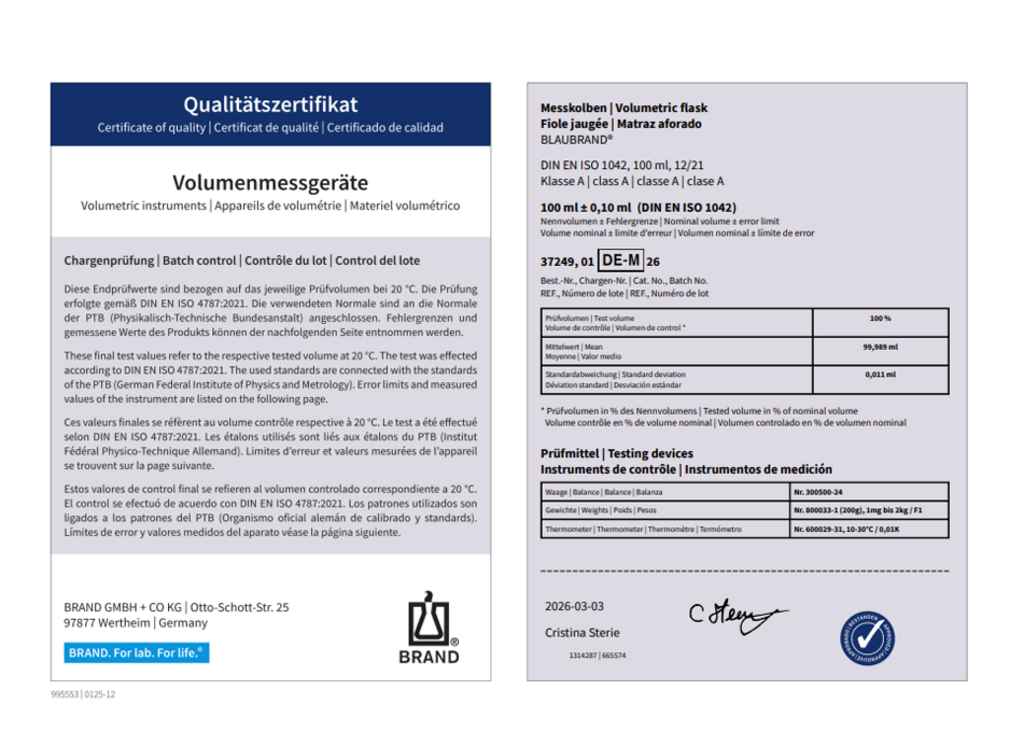
- as a batch certificate (factory calibration according to DIN EN ISO 4787)
Content: Mean value and standard deviation of the batch, date, traceability of the measuring equipment
Basis: Instrument standards such as DIN EN ISO 1042 (volumetric flasks), 4788 (graduated cylinders), 385/648/835 (burettes/pipettes)
Use: Routine work when batch documentation is sufficient
- as an individual certificate (factory calibration for each instrument)
Content: Test values for the specific individual instrument
Advantage: Clear traceability at serial number/instrument level
Use: When individual documentation is required
- as a USP certificate (batch or individual certificate)
Zweck: Bestätigung der Fehlergrenzen der United States Pharmacopeia
Einsatz: Analysen und Verfahren mit explizitem USP‑Bezug
DAkkS calibration certificate (by an accredited laboratory)
Purpose: Independent, accredited proof of calibration with traceability
Use: Expert reports (e.g. forensic, medical, technical), regulatory requirements, accreditation obligations
At BRAND, many volumetric instruments are available on request directly with a DAkkS calibration certificate from our calibration laboratory accredited according to DIN EN ISO/IEC 17025.
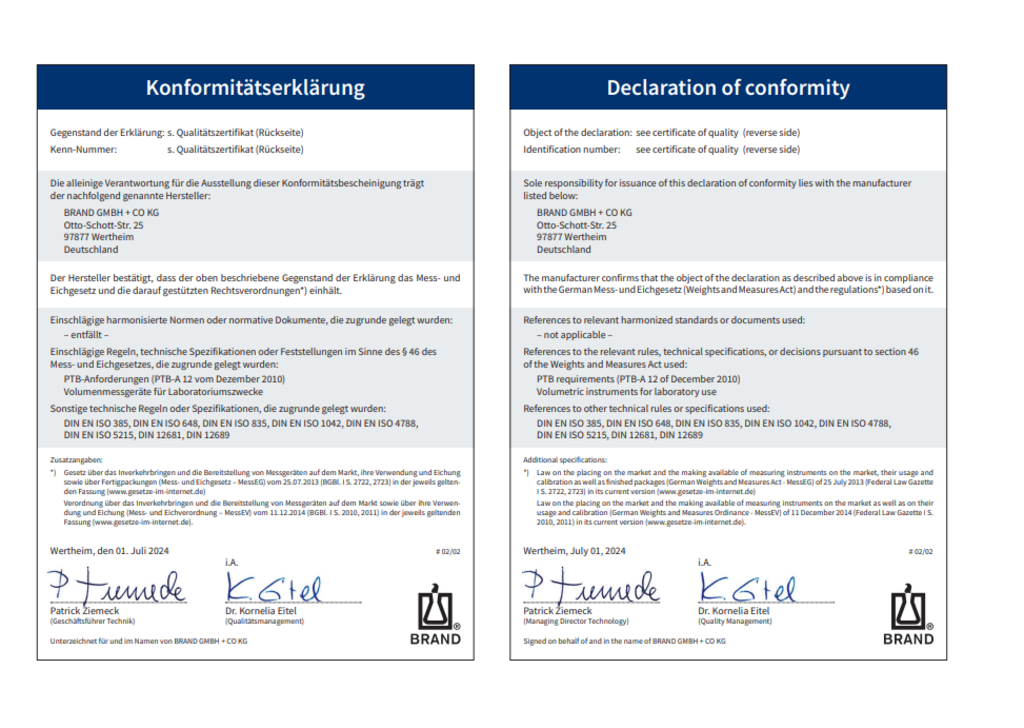
Declaration of conformity
DE-M marking (legally regulated measurement sector)
Meaning: Conformity with the German Measuring Instruments Ordinance
Relevance: For instruments that are kept available or used in the legally regulated sector
Selection guide at a glance
Routine use with general traceability → Batch certificate
Instrument-specific traceability → Individual certificate
Pharma/USP requirements → USP certificate (batch or individual instrument)
Expert reports (particularly in the public sector) → DAkkS calibration certificate
Which standards apply to volumetric instruments?
Volumetric instruments are subject to a general basic standard, specific product standards for each type of instrument, and a central testing standard for calibration and application:
What is described?
Where is it described?
DIN EN ISO 384
DIN EN ISO 4787
Guidelines/books/standards from other fields/etc.
Overview of the requirements for individual volumetric measuring instruments:
Instrument (Glass/Plastic)
ISO Standard
USP/ASTM Standard
DIN EN ISO 648 (Glass)
USP Chapter 31/ ASTM E969
DIN EN ISO 835 (Glass)
USP Chapter 31 (ASTM E 1293)
DIN EN ISO 1042 (Glass)
DIN EN ISO 5215 (Plastic)
USP Chapter 31/ASTM E 288
DIN EN ISO 4788 (Glass)
ISO 6706/ DIN 12681 (Plastic)
USP Chapter 31 (ASTM E 1272)
DIN EN ISO 385 (Glass)
USP Chapter 31/ASTM E 1189 & 287
Details for comparison: G.I.T. Laboratory Journal 9–10 / 2013, pp. 33–35
Sources
Jander Jahr Maßanalyse (17. Auflage)
G.I.T. Laboratory Journal 9-10 / 2013, pp 33-35
FAQ
BLAUBRAND® volumetric instruments offer verified accuracy (Class A/AS), reliable certificates and durable materials from Germany. Each glass volumetric instrument is individually adjusted at BRAND. In addition, BRAND uses high-quality printing inks that, together with the firing process, have been specially developed for glass volumetric instruments and ensure good readability even after many washing cycles. This ensures reproducible results.
Glass erosion is mainly caused by cleaning. Find out more about cleaning volumetric instruments here.
The reference temperature, 20 °C for BLAUBRAND, is the fixed reference point for which the adjustment of volumetric instruments is designed. This means that volume and tolerances refer to 20 °C. If work is carried out at a different temperature, additional deviations occur, which are taken into account through documented corrections. From a physical point of view, the volume of the liquid changes with changes in temperature. The instrument also has this dependency, so the reference temperature ensures comparability. If work is carried out at a different temperature, additional deviations occur, which are taken into account through documented corrections.
Glass volumetric instruments are used for most laboratory applications because they are dimensionally stable, chemically resistant and very accurate. Plastic volumetric instruments are used when glass is unsuitable, for example when working with hydrofluoric acid (HF) or in certain analyses or in the field of trace analysis.
Regular cleaning in particular causes gradual erosion of the glass surface. The extent of this erosion depends on several factors: the duration of cleaning, the temperature, the type and concentration of the detergent, and the pH value of the cleaning solution used. The longer and more intensive the exposure, the greater the glass erosion can be. This material loss of just a few micrometers leads to changes in volume and generally cannot be detected.
To ensure that volumetric instruments continue to meet the required accuracy, they should be checked regularly.
The main difference lies in their design and intended use.
A volumetric flask has a bulb-shaped body that contains most of the volume, as well as a narrow neck. For example, a 100 ml volumetric flask from BRAND has an inner neck diameter of approximately 13 mm.
Advantage: High measurement accuracy with a small error limit (e.g. ± 0.1 ml).
Disadvantage: Only the indicated nominal volume can be set precisely.
100 ml graduated cylinders are cylindrical in shape and have a significantly larger inner diameter, typically around 24–30 mm. They have a scale and allow different volumes to be measured within their measuring range.
Advantage: Flexible volume measurement.
Disadvantage: Lower accuracy and higher error limits (e.g. ± 0.5 ml).


