Air-displacement or positive-displacement pipette? Find the right BRAND pipetting system for your application
Selecting the correct liquid handling device based on the medium used, the delivery volume, and the frequency of delivery is essential for precise and reliable work. The device must also provide optimum support for the application and contribute to efficiency in the laboratory.
BRAND provides various air displacement pipettes and repetitive pipettes, including the Transferpette®, HandyStep®, and Transferpettor product lines. In this extended edition of the BRAND Pipette Basics, you will learn about the key differences between these two pipetting principles.
What is the difference between air-displacement and positive-displacement pipettes?
The key difference lies in how the force from the piston is transferred to the liquid:
The air displacement principle
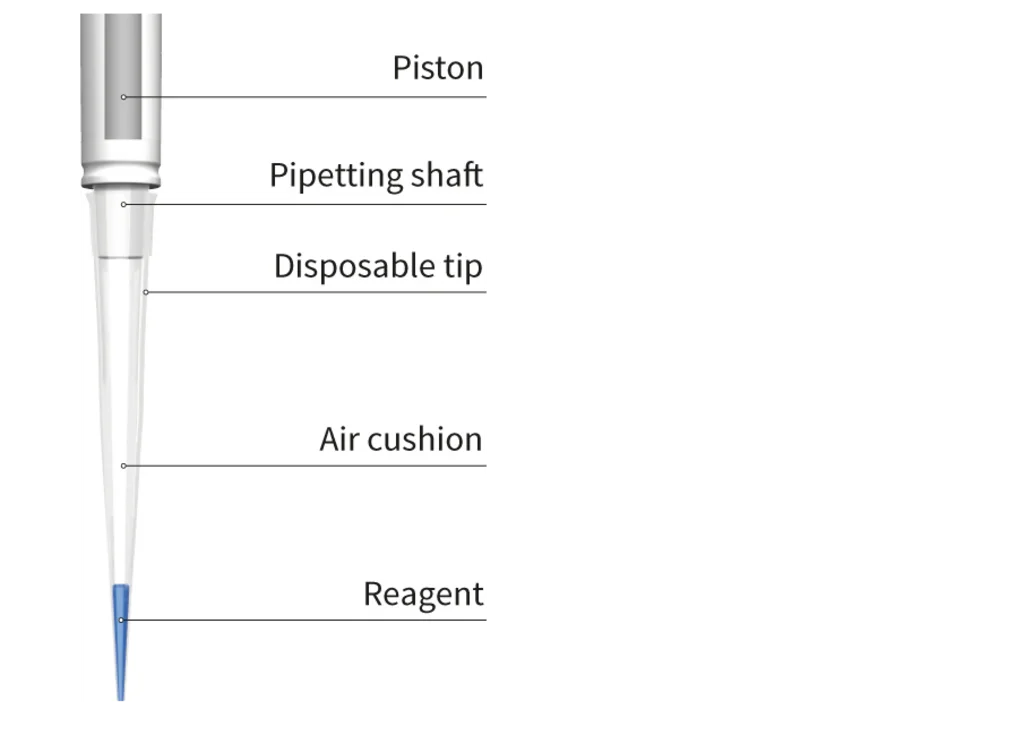
The air displacement principle is used mainly for pipettes and enables precise dispensing with fast and easy handling. By moving the piston in the pipette shaft up and down, a negative or positive pressure is created. This causes liquid to be aspirated into or expelled from the tip. However, the liquid is always separated from the inner piston and the pipette shaft by an air cushion and does not come into contact with the pipette itself when handled correctly. This enables contamination-free yet simple handling with the highest precision. But this is also where the application limits of the system lie. Media that strongly influence the air cushion can affect the accuracy of the result. For example, liquids with high viscosity or highly volatile media make precise work difficult. In these cases, the techniques described here and the temporary User Adjustment feature of the Transferpette® pro can help improve results.
The positive displacement principle
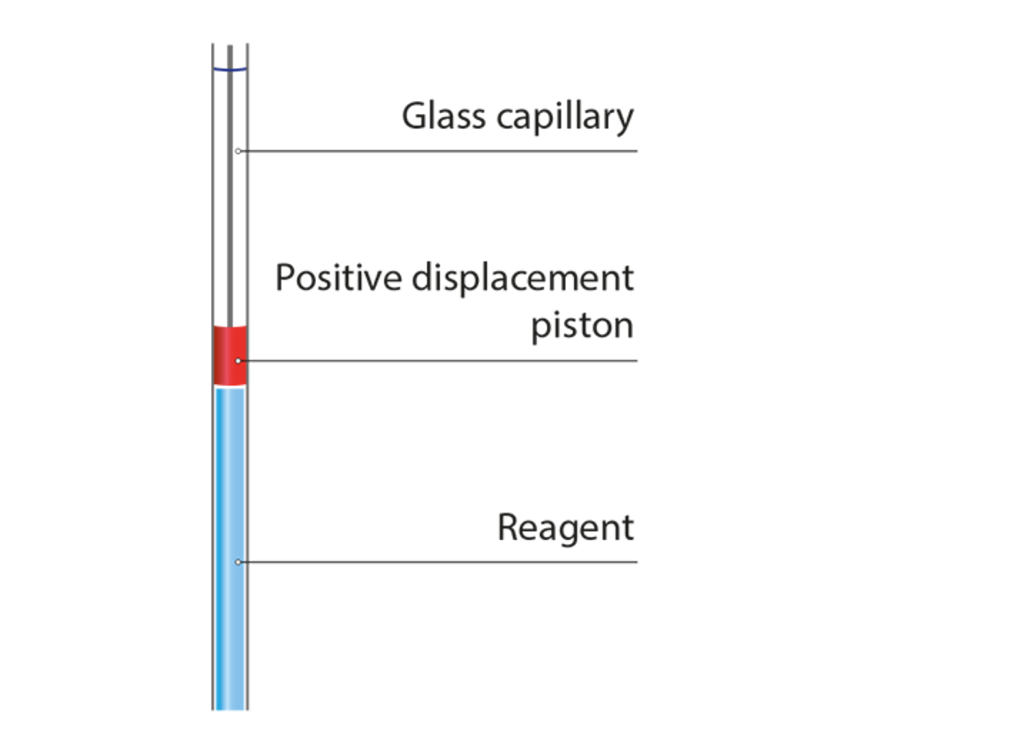
The positive displacement principle is often used for repetitive pipettes or specialized positive displacement pipettes. In contrast to air displacement systems, the piston of the positive displacement pipette is in direct contact with the liquid to be pipetted. The piston aspirates the liquid through a vacuum and wipes the walls of the tip clean during dispensing – down to the last drop, which clearly leaves the tip. This principle ensures highly reproducible results regardless of the liquid and the influence of an air cushion. The piston, which is built into the device in air displacement models, is located in the tip cylinder in positive displacement models and must always be replaced in order to ensure contamination-free operation. Depending on the model, this can result in more time needed to change the tip and higher consumable costs.
Advantages and Limits
Working principle
Vorteile
Grenzen
Easy and quick exchange of pipette tips
Fast serial pipetting of long test series
Pipetting of problematic solutions (high viscosity, highly volatile, high density or foaming) limited
Air cushion depends on many factors
Replacing the tip can be time-consuming
Higher costs for tips
With this technical background in mind, and considering the advantages and limitations of both systems, the next step is to select the right instrument for the user.
BRAND's large portfolio makes it possible to provide the right device for every user, both for positive displacement pipettes and for air displacement pipettes.
Air-displacement pipettes from BRAND
With the Transferpette® range, BRAND offers manual and electronic air-displacement pipettes for a wide variety of applications and volume ranges.
The Transferpette® S and Transferpette® pro enable true one-handed operation. The single-channel models cover volumes from 0.1 µl to 10 ml. For microplates, PCR plates, and deep-well plates, the 8- and 12-channel pipettes cover a volume range from 0.5 µl to 300 µl (Transferpette® S) or up to 1250 µl (Transferpette® pro).
The Transferpette® electronic also offers functions such as mixing, reverse pipetting, and dispensing, making it particularly suitable for repetitive pipetting tasks.


Positive-displacement pipettes from BRAND
With the HandyStep® touch, HandyStep® S, and Transferpettor, BRAND offers a range of positive-displacement systems for challenging liquids and repetitive dispensing.
The HandyStep® models are particularly suitable for quickly dispensing long series as well as for handling viscous, volatile, or foaming liquids. The HandyStep® touch is operated electronically via a touchscreen, while the HandyStep® S is entirely mechanical.
The Transferpettor is a positive-displacement pipette designed for liquids that are difficult to pipette, such as highly viscous, foaming, or volatile liquids.


