Choosing the right pipette for your application Find the right BRAND pipetting system for your application
The criteria used to select the optimal device are as varied as the different models on the market. The properties of the medium used are often the limiting factor in the selection process and determine the use of a positive displacement pipette. The properties of the medium used is therefore one of the most important criteria in selecting a suitable dispensing system. There is often a large selection even within a group and there are usually many different models that all work according to the same principle.
For this reason, the requirements of the application must also be considered. For example, it is necessary to check how often a delivery must be repeated, which vessels are used, or which volume is required. A device must therefore optimally support users in their work; it must be intuitive to operate, deliver accurate
volumes, and meet the necessary requirements.
The following explanations are intended to show the differences between the individual devices so that a decision can be made more easily.
Selection based on the medium used
The medium used has a decisive influence, especially in devices that work according to the air displacement principle, and can negatively affect the accuracy of dispensing. Certain media can make precise and reproducible work with the air displacement models difficult or even impossible:
- High viscosity or wetting media
- High density media
- Foaming media (e.g., detergents)
- Highly volatile liquids
- Infectious media
With a certain amount of experience and using special techniques (e.g., reverse pipetting, the use of surface-treated low retention tips, saturation of the air cushion by repeated intake and delivery of the medium before the actual pipetting step, and working slowly), these media can also be used to some extent in air displacement models.
Most frequently, high-viscosity media in particular, cause problems and inevitably lead to the change to positive displacement. Of course, proper technique (e.g., slow dispensing) offers optimization possibilities. But as can be seen from the viscosity limits of the individual devices, the differences are clear.
Air displacement pipettes
Positive displacement pipettes
Repetitive pipettes
Up to 260 mPa s
Up to 140.000 mm2/s (100 µl nominal volume with Transferpettor micro)
Up to 40.000 mm2/s (500 µl nominal volume with Transferpettor macro)
20 mPa s at 50 ml PD-Tip
260 mPa s at 5 ml PD-Tip
977 mPa s at 1.25 ml PD-Tip
In these or similar cases, a positive displacement model should be used. Because of the direct contact to the piston,
the influence of the air cushion is eliminated, and exact working without loss of accuracy is guaranteed.
Selection based on the volume range
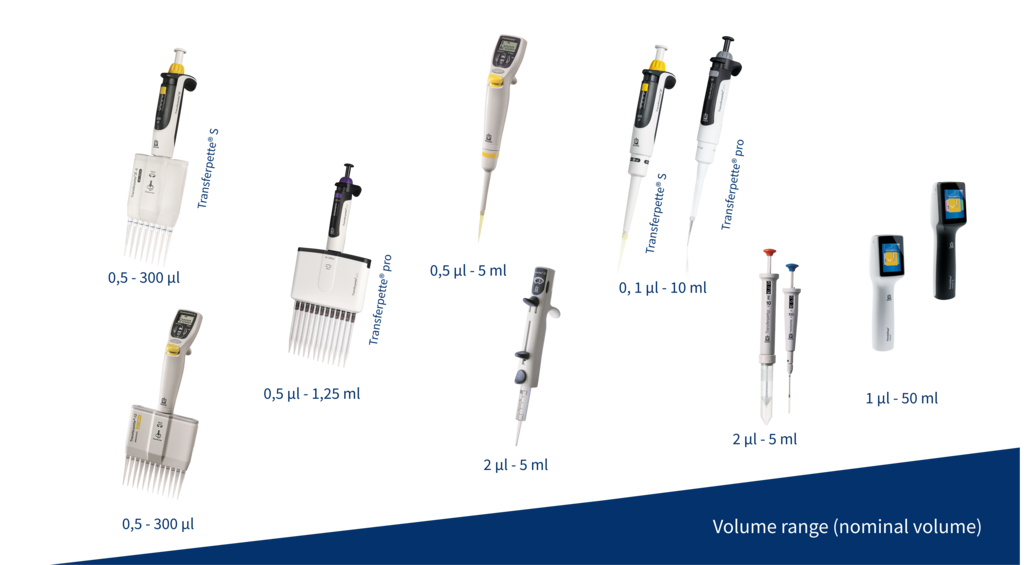
In addition to the usability of the medium, the volume range can be a further criterion according to which the dispensing unit is selected. Devices such as the Transferpette®, which must work with high precision in small volume ranges, cover only a limited volume range. However, it is extremely important for the application that the desired volume can be dispensed in a single step in order to achieve reproducibility. It is therefore necessary to check which range must be covered and which device has the necessary requirements for this.
Selection based on the number of deliveries
Both the volume to be dispensed and the frequency of dispensing are decisive. In some experiments, each sample must be dispensed individually. However, it some cases, it is useful if a volume can be dispensed several times in succession or even in parallel. Here too, the possibilities are as varied as the applications themselves.
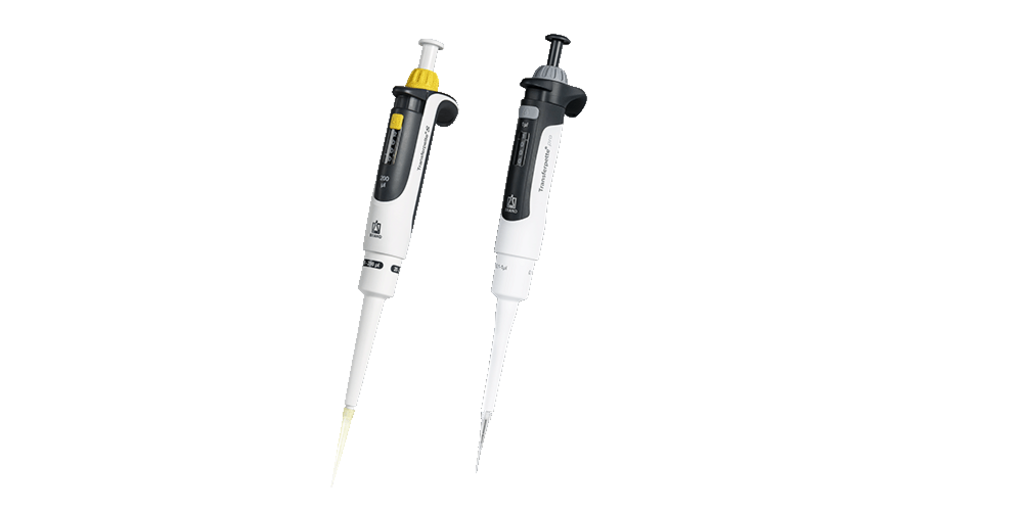
If it is absolutely necessary for the application to dispense a single volume without risk of contamination, single-channel pipettes – such as the Transferpette® pro or Transferpette® S – are suitable for this purpose. This is often the case when valuable samples or molecular diagnostic tests are involved. The continuous change of pipette tips – which is quick and easy – reliably prevents sample mixing and contamination.
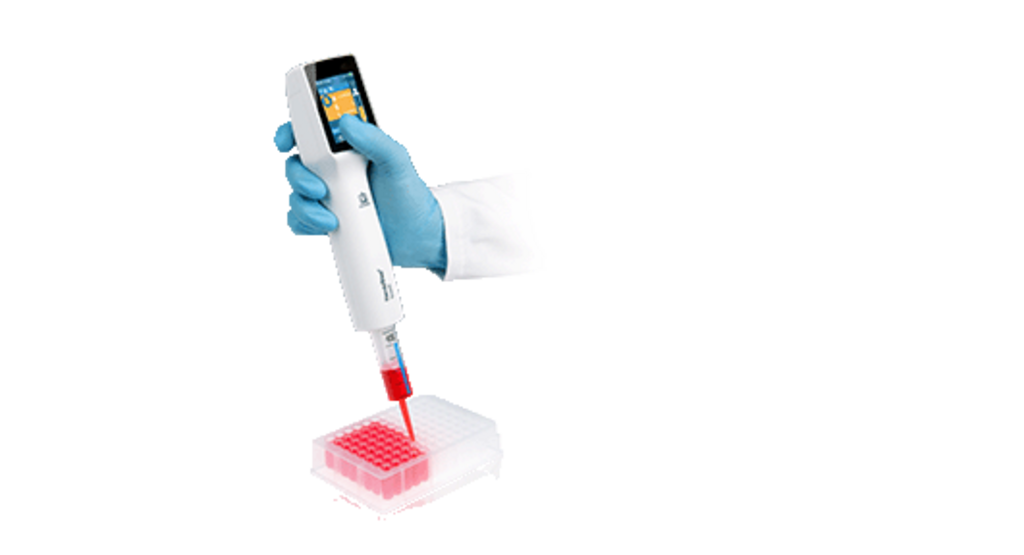
But what can you do if the medium is not suitable for use with the air displacement pipette? Even for problematic liquids, BRAND has a solution that ensures contamination-free work. With the electronic HandyStep® touch and its pipetting function, the repetitive pipette turns into a practical positive displacement pipette. The PD tips ensure that no contamination occurs and allow even critical solutions to be handled safely.
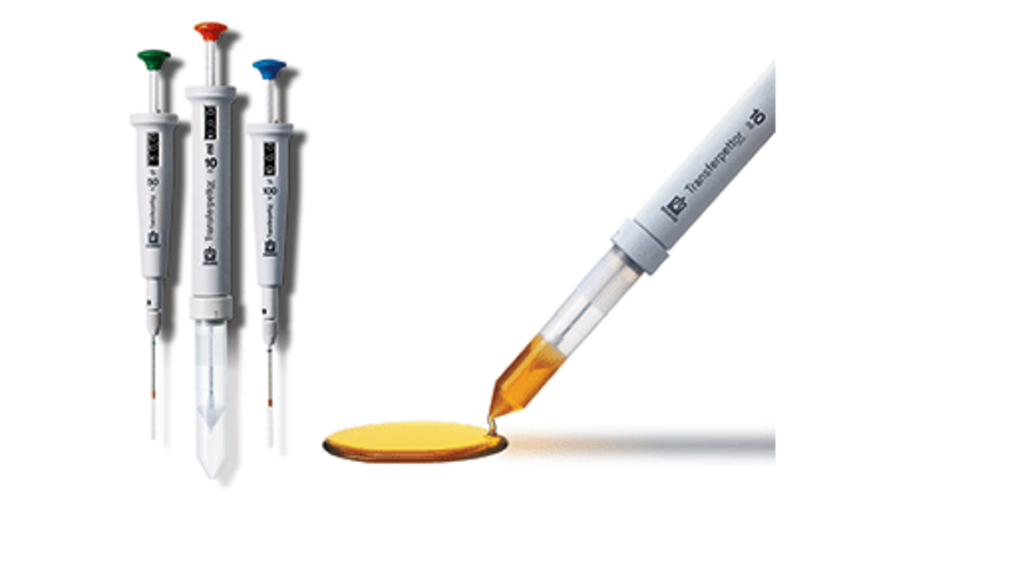
The Transferpettor is ideal if you only occasionally need to dispense problematic solutions and preventing contamination is not your top priority. Thanks to its longer tip use, the positive displacement pipettes can facilitate routine disposable applications and save time and money compared with the repetitive pipette, which requires regular tip changes.
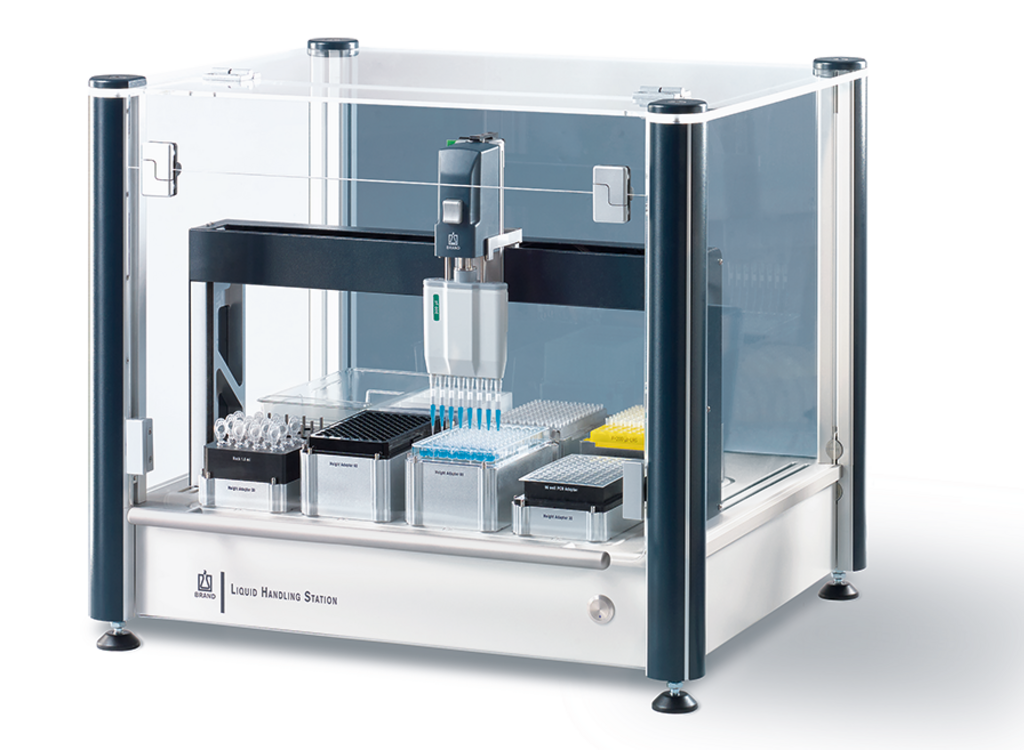
However, if a procedure is complex and time consuming, it may be useful to fill several vessels or wells in parallel. Dispensing individual reagents in several wells saves time and allows a reproducible procedure. Depending on the vessels used, different systems can be used to simplify the application. If the customer uses plates in SLAS/ANSI format, multichannel pipettes or a pipetting robot like the Liquid Handling Station from BRAND are ideal for filling several wells in parallel. The distances correspond exactly to this format, and 8 or 12 wells can be reliably filled in parallel. Depending on the desired volume, the Transferpette® electronic can also be used to fill several rows up to entire plates.
Things become a bit more complicated if the desired vessels do not correspond to a standard SLAS/ANSI format.
Multi-channel systems can not be used in such cases. BRAND also offers a convenient solution for this. With the Transferpette® electronic in dispensing mode, the HandyStep® S, or HandyStep® touch/touch S, continuous multiple dispensing into each vessel is possible.
Depending on the complexity of the application, it ranges from manual dispensing to complex series with the HandyStep® touch S. Here, too, the workload can be greatly reduced, and reliable and precise dispensing is guaranteed.
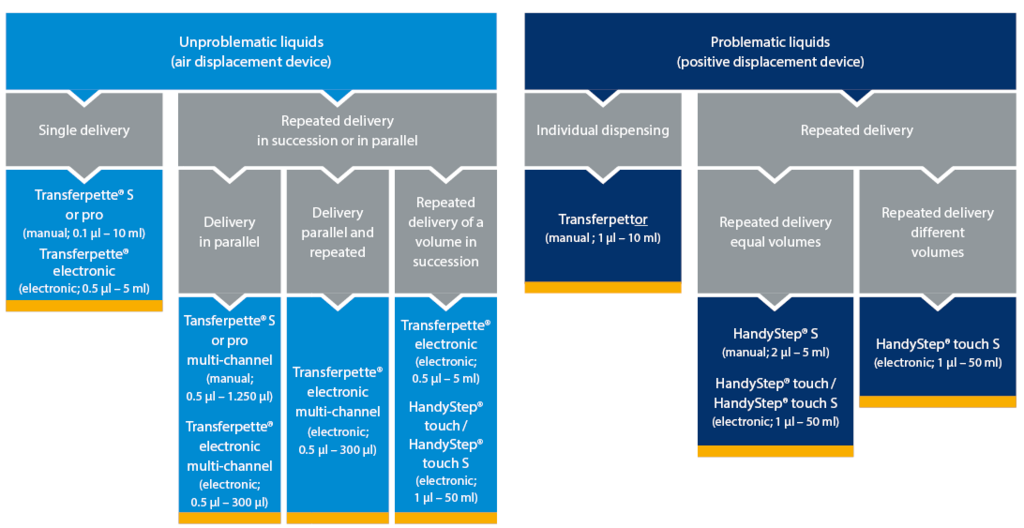
Summary - How to choose the right pipette
The following overviews summarize the criteria described above and provide a practical guide to choosing the right pipette.
Device
Positive displacement / air displacement model
Volume range
Delivery options
Air displacement pipette
0,1 µl – 10 ml
Single delivery
Air displacement pipette
0,5 µl – 300 µl
Multiple deliveries in parallel
Air displacement pipette
0,5 µl – 1.250 µl
Multiple deliveries in parallel
Air displacement pipette
0,5 µl – 5 ml
Step-by-step dispensing possible
Air displacement pipette
0,5 µl – 300 µl
Multiple deliveries in parallel; Step-by-step dispensing possible
Positive displacement pipette
1 µl – 10 ml
Single delivery
Repetitive pipette / Positive displacement pipette
2 µl – 5 ml
Step-by-step dispensing possible
Repetitive pipette / Positive displacement pipette
1 µl – 50 ml
Stepwise dispensing possible; illustration of complex dispensing processes, also single delivery in pipetting mode available