Menu
BRAND. For lab. For life.®

Volumetric measurement

BRAND Basics

Liquid Meniscus explained

Accurate volume measurements in the laboratory depend on correctly reading the meniscus, also known as the liquid meniscus.

This article explains what a meniscus is, why it forms, and how to measure liquid volumes precisely using graduated laboratory glassware and plasticware.

What is a liquid meniscus?

The term meniscus describes a curvature in the surface of the liquid. The meniscus may be curving upwards or downwards. The curvature develops as a function of the interplay between the adhesion and cohesion forces. 

If the diameter of a pipette is narrow enough – as with capillary pipettes – the adhesion force is strong enough to pull up not only the edge but also the entire liquid level (capillary effect).

Picture of BRAND Volumetric Instruments

What is the difference between a Concave and Convex Meniscus?

The difference between a concave and convex meniscus lies in the shape of the liquid surface and the balance between adhesion (attraction between the liquid and the container) and cohesion (attraction between liquid molecules).

Picture of a Concave meniscus in a graduated pipette

Concave meniscus in a graduated pipette

If the liquid molecules are attracted more strongly by the glass wall (adhesion) than by their own kind (cohesion), the meniscus is curved downwards, or concave; the edge of the liquid surface is slightly raised. This is the case, e.g., with aqueous solutions.

Picture of Convex meniscus in a graduated pipette

Convex meniscus in a graduated pipette

If the cohesion force of a fluid is stronger than the adhesion force of the glass wall, an upwardly curved (convex) meniscus is formed. This happens with mercury, for example.

How to read a meniscus correctly

1. Get on Eye Level: 

For parallax-free adjustment of the meniscus, the volumetric instrument is held upright and the observer’s eye must be at the same height as the meniscus. 

In this position the ring mark will appear as a line. 

2. Read the meniscus

Picture of a Concave meniscus in a graduated pipette

a) Read a concave meniscus

In the case of a concave meniscus, the volume has to be read at the lowest point of the liquid level. The lowest point of the meniscus has to touch the upper edge of the graduation mark.

Picture of Convex meniscus in a graduated pipette

b) Read a convex meniscus

With the meniscus curved upwards, the volume should be read at the highest point of the liquid level (edge). During the reading, the highest point must touch the upper edge of the graduation mark.

Picture of meniscus at the Schellbach stripe in a burette

c) Read the meniscus at the Schellbach stripe in a burette

The Schellbach stripe is a narrow blue band at the center of a white stripe. Schellbach stripes are imprinted on the back of volumetric instruments to improve readability. The refraction of light causes two arrow points to appear at the meniscus. The reading point is where the two arrows meet.

Tipp: Use dark paper as a reading aid.


The meniscus will appear darker and more easily readable in front of a light background if a piece of dark paper is held behind the instrument immediately beneath the ring mark or graduation mark.
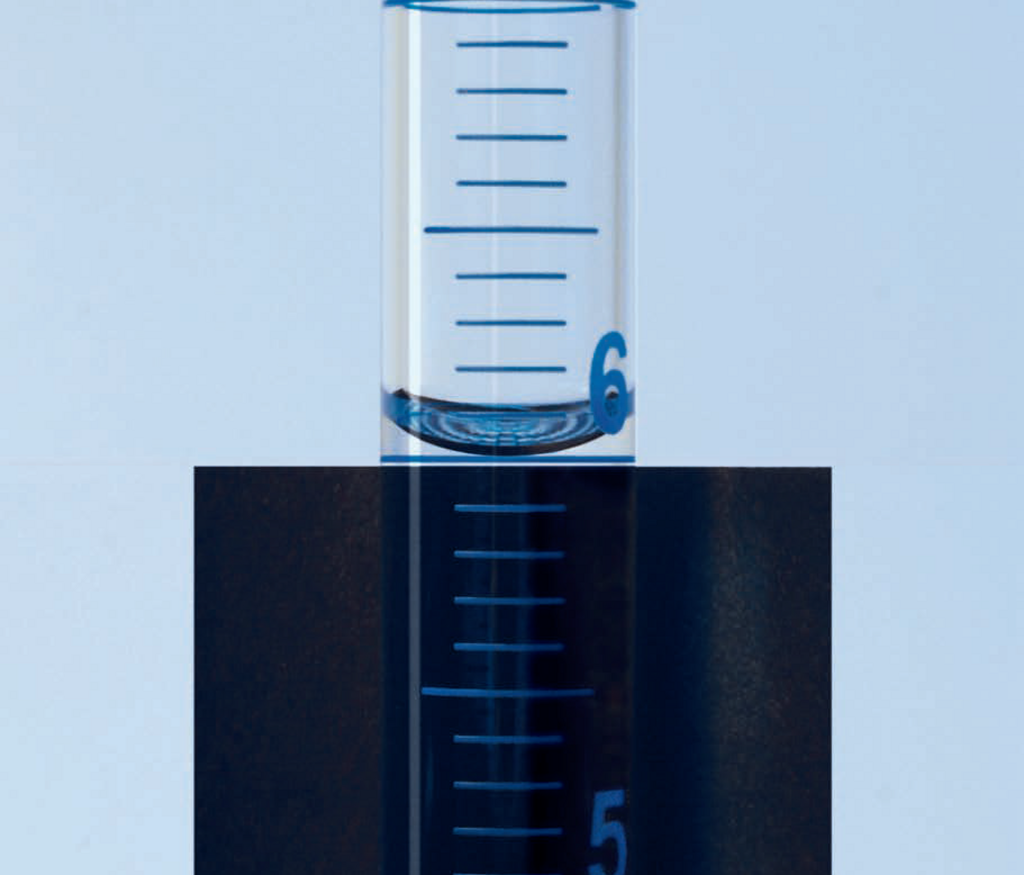
Meniskus
Important note:
The temperature of the liquid and the environment during use are important. While the expansion of a glass volumetric instrument is negligible, the expansion of the liquid at different temperatures must be taken into account. To minimize volume errors as much as possible, the volumes of all the liquids in contact with one another should be measured at a common (prevailing daily) temperature. Especially in the preparation of standard solutions, for example, the pipetting of the samples and the titration should be done at the same temperature to the extent possible. Significant temperature differences between the measuring instrument and the liquid should likewise be avoided.

Quick Checklist for reading the meniscus

Before recording your measurement, ask yourself:


✓ Is my eye level with the meniscus?

✓ Am I reading the correct part of the meniscus (bottom for water, top for mercury)?

✓ Is the cylinder standing upright?

✓ Has the liquid stopped moving?

✓ Have I estimated one extra digit?

Documents download

BLAUBRAND Volumetric Instruments

Videos | mp4 | 25 MB

BLAUBRAND® Volumetric instruments

Brochure | pdf | 3 MB

BLAUBRAND® Volumetric Instruments and Density Bottles

Testing instructions (SOP) | pdf | 1 MB

Life Science Catalog

Brochure | pdf | 17 MB

Volumetric Measurement

Brochure | pdf | 4 MB

BRAND GMBH + CO KG

Otto-Schott-Str. 25
97877 Wertheim
Germany


info@brand.de

T +49 9342 808 0

General terms and conditions

for orders from outside shop.brand.de

for online orders on shop.brand.de

Delivery countries for online orders on shop.brand.de

Secure payment

Note: Our offer is directed exclusively to traders.

Subscribe to our Newsletter

I can revoke this consent at any time with effect for the future by contacting privacy@brand.de. Further information on data processing can be found in the privacy statement.

By submitting the contact form, you agree that your data will be used to process your request. If your inquiry originates from a country where we do not have our own sales department, you also consent to the forwarding of your data to the responsible local sales partner. You can find an overview of our sales partners on our contact page. Further information on data processing, including possible transfers to third countries, can be found in our privacy statement.

Fields marked with * are required.