Working with bulb and volumetric pipettes
Pipettes are volumetric instruments for measuring volumes of liquid and are generally calibrated 'to deliver'. During the manufacturing process, they are individually volumetrically calibrated and provided with one or more calibration marks.
We distinguish between bulb pipettes and graduated pipettes (calibrated to deliver, TD, Ex), disposable micropipettes up to 200 μl (calibrated to contain, TC, In) and mechanic or electronic micropipettes, also called air-cushion pipettes.
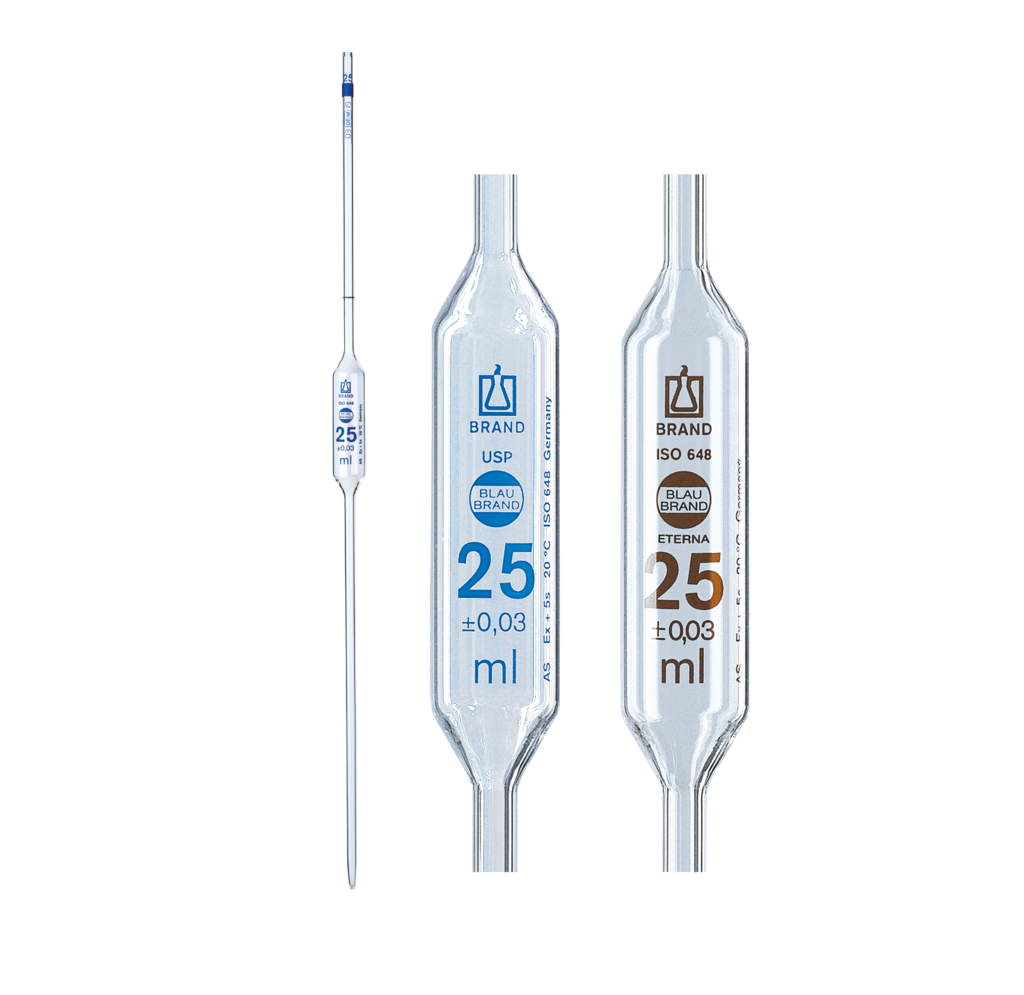
Bulb pipettes
→ Bulb pipettes are also called single volume pipettes.
→ Calibration:
Class AS: 'Ex + 5 s'
Class B: 'Ex'
→ Generally higher measurement accuracy than graduated pipettes
→ Bulb pipette models:
The most important model is the bulb pipette with 1 mark
(total delivery).
Less common is the model with 2 marks (partial delivery).
Graduated pipettes
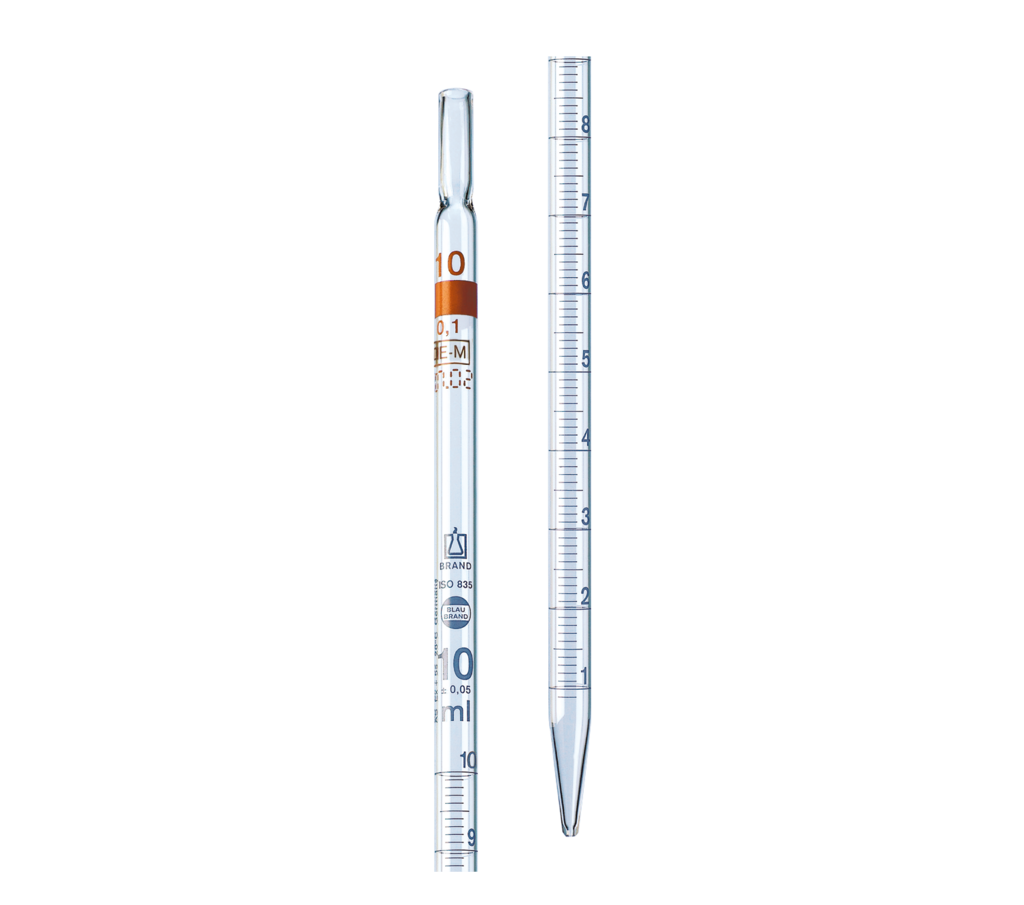
→ Calibration:
Class AS: 'Ex + 5 s'
Class B: ‘Ex’
→ Scaling permits the reading of partial volumes
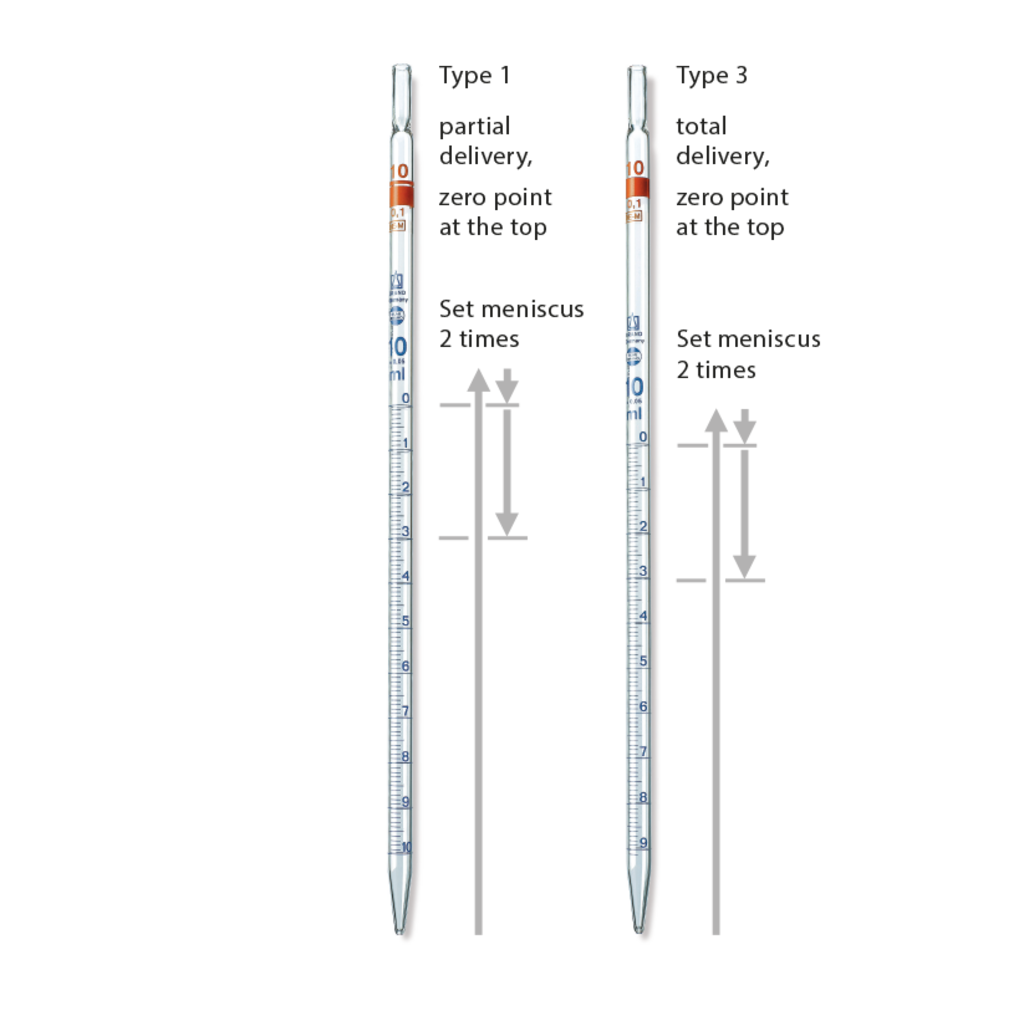
→ Types of graduated pipettes:
Type 2 – nominal volume at top, total delivery also for partial
volumes
Type 1 – nominal volume at bottom, partial delivery for all
volumes
Type 3 – nominal volume at bottom, total delivery only for
the nominal volume
How to work with bulb pipettes and graduated pipettes type 2
Filling
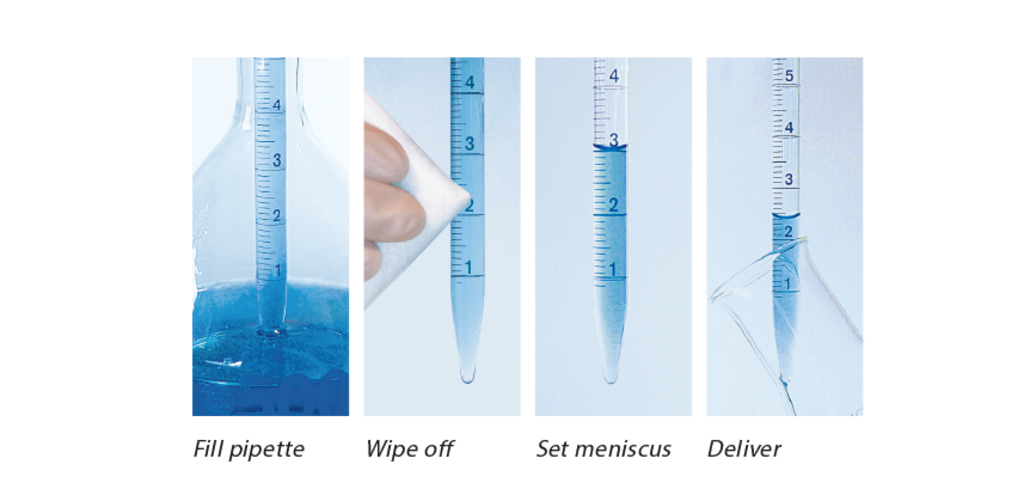
1. Fill the pipette with a pipetting aid to approx. 5 mm above the selected graduation mark.
2. Remove any liquid remaining on the outside of the tip of the pipette with a tissue.
3. Set the meniscus.
4. Wipe off any drop of liquid adhering to the tip.
Delivering
5. Hold the pipette vertically. Deliver the liquid with the tip of the pipette in contact with the inner surface of the inclined receiving vessel.
6. When the meniscus comes to a rest in the tip, the waiting time of 5 s begins (class AS only).
7. After the waiting time, draw the pipette tip upwards along the inner wall through a distance of about 10 mm to remove residual liquid.
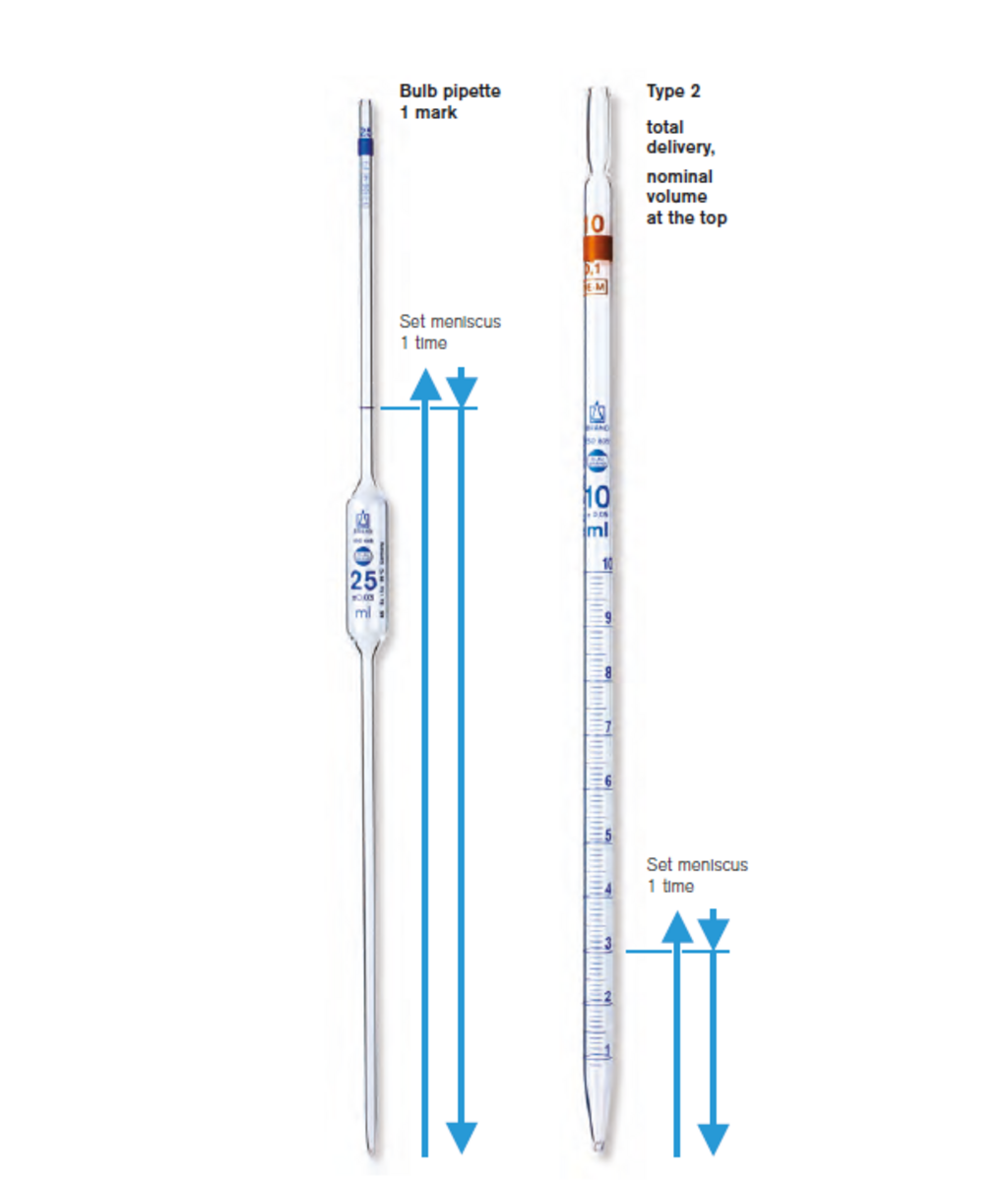
Working with type 2 graduated pipettes is significantly quicker and simpler. With type 1 and type 3 pipettes there is a risk that with the always necessary second meniscus setting too much liquid is released, and that the sample needs to be prepared again (as also with bulb pipettes that have 2 marks).
How to work with graduated pipettes type 1 and type 3
When using type 1 or type 3 graduated pipettes (zero point at top), the meniscus must
1. first be set at the zero point and then the liquid be run out to slightly above the desired partial volume.
2. After a waiting time of 5 s, the meniscus should be set a second time.
FAQ
You can choose between different pipette controllers/aids vom BRAND:
- macro pipette controller (easy manual handling)
- accu-jet S (motorized controller)
- classic pipette fillers (also named Peleus Ball)

